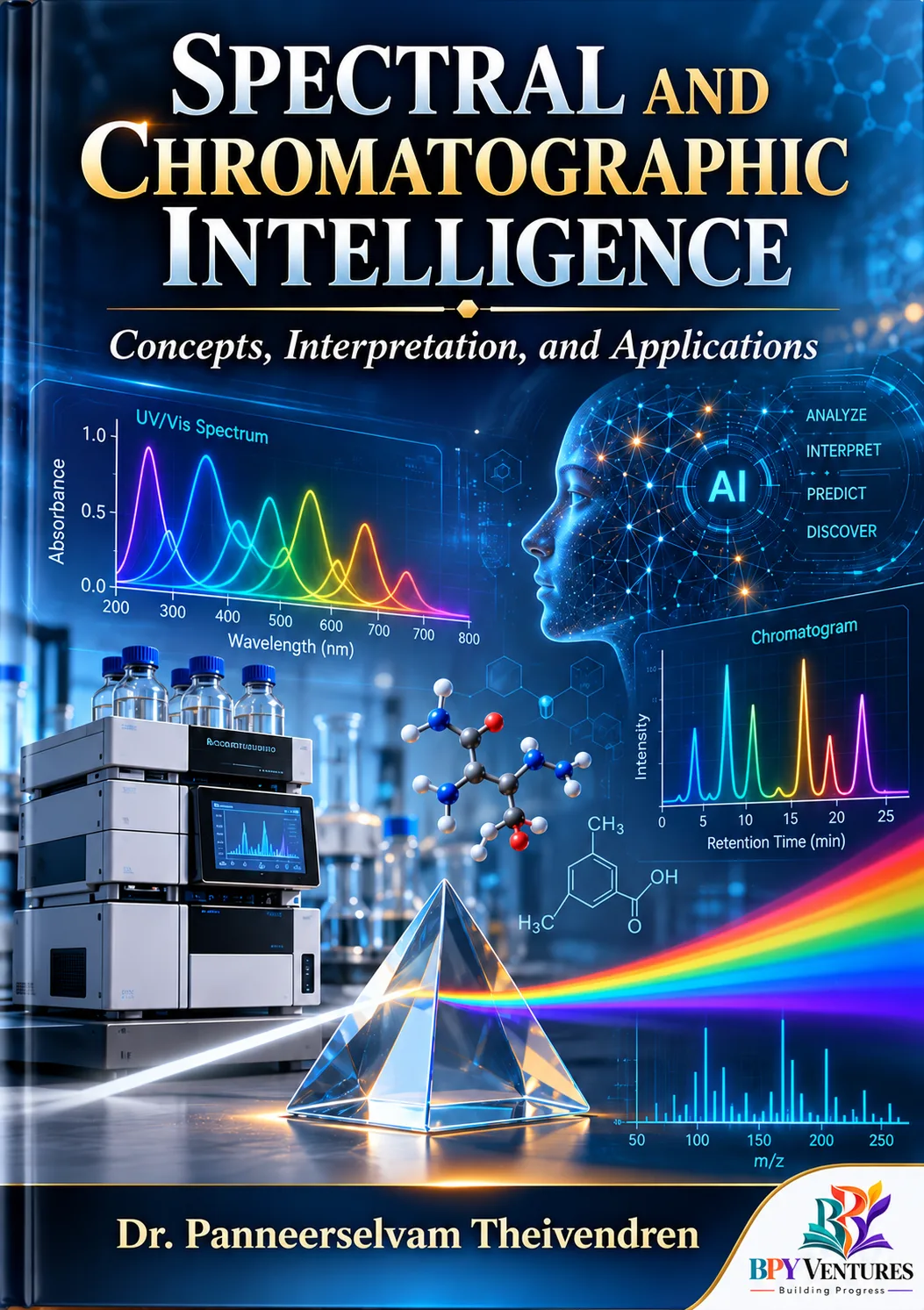
Cover of SPECTRAL AND CHROMATOGRAPHIC INTELLIGENCE

Pharmaceutical Sciences

SPECTRAL AND CHROMATOGRAPHIC INTELLIGENCE

Concepts, Interpretation, and Applications

Panneerselvam Theivendren

Spectral and Chromatographic Intelligence: Concepts, Interpretation, and Applications is organised in five parts that follow the natural progression of analytical learning.
• Part I — Foundations of Analytical Intelligence introduces analytical performance characteristics (sensitivity, selectivity, accuracy, precision, detection limits) and the molecular basis of analytical signals.
• Part II — Spectroscopic Intelligence covers UV–visible, infrared/FTIR, NMR, mass spectrometry, fluorescence, Raman and atomic spectroscopy, with emphasis on what each signal reveals about structure.
• Part III — Chromatographic Intelligence develops separation theory and then applies it to planar chromatography, HPLC, GC and hyphenated techniques.
• Part IV — Interpretation and Analytical Problem Solving integrates the techniques: combined structure elucidation, systematic chromatogram interpretation and troubleshooting, and method development and validation within a Quality by Design framework.
• Part V — Applications and Future Analytical Intelligence surveys pharmaceutical, biomedical, food, environmental and forensic applications, and examines chemometrics and artificial intelligence.
ISBN
9789334561623
Published
2026
Pages
281
Language
https://doi.org/10.5281/zenodo.23493955 (English)

About the author

Panneerselvam Theivendren

Panneerselvam Theivendren

Dr. Panneerselvam Theivendren, recognised among the World’s Top 2% Scientists in the Stanford University/Elsevier 2026 database, is a Professor of Pharmaceutical Chemistry & Analysis at VISTAS, Chennai. His expertise includes medicinal chemistry, molecular modelling, drug design, pharmaceutical analysis, and AI-assisted drug discovery. His research focuses on cancer therapeutics, nanotechnology, neurodegenerative diseases, and phytochemistry. With 4,045 Google Scholar citations, an H-index of 35, and an i10-index of 91, he actively advances interdisciplinary pharmaceutical research by integrating computational modelling, artificial intelligence, and experimental approaches to develop innovative therapeutics.